Tuesday, April 20, 2010

A Note on the Trinity (2)

This post follows on from my last and briefly addresses the practical aspect of the Trinity. It is the second part of a two part response to the questions:

Is the Trinity understandable? Is the Trinity practical?


Read the first part here.
-------------------------------------------

The Trinity expresses God as relationship. Empathy and openness is the basis for all relationships. It is the basis for love itself, and God is love. To love, one must be in relationship, and God being love, rather than simply loving, explains that God is in relationship.

In fact, God is relationship, without remainder. The Father, Son and Spirit are in relationship with one another in such a way that there is no part of one that is not given to the others in relationship. This relationship was in existence before the dawn of time and space, showing that relationship is fundamental to all reality.

This understanding of the Trinity means that it is not just a theological truth to be learnt, but it is an ethical truth to be lived out. The way we think of God impacts on the way we live our lives, the things we do and the things we say. As Christians, we are caught up in the Trinitarian relationship, the eternal dance of perichoresis.

We live our lives in communion with God: Father, Son and Spirit. Our worship is offered to God, Three-in-One; our prayers are offered to Father, Spirit and Son. More than this, as Trinitarians, we live our lives in community with each other, reflecting God’s relational communion. This does not mean uniformity or conformity, but rather relationship embracing diversity, bringing unity.

Relationship without remainder.

Trinitarians.

A Note on the Trinity

As part of my studies in theology, questions about the Trinity have been posed for reflection and response. The following is my response to the question:

Is the Trinity understandable? Is the Trinity practical?

The response is in two parts. The first part (this post) responds to the first question. The second (see the next post here) suggests how that might play out for us, very briefly.

-------------------------------------------------

The Trinity is a description of God as Father, Son and Holy Spirit. It comes from the Latin word Trinitas, first introduced by the theologian Tertullian who lived between 160 and 225AD. Tertullian was trying to explain how God is one being and yet three persons.

The Father, Son and Spirit are not three separate and independent “Gods”; nor are they three different “states” of the one God. They are three persons-in-community, living as equals with each other as one God. They are inseparable, living in unbreakable communion with one another. One cannot be isolated from another. There is no first or last, no authority over another, no conflict or rivalry. More than that, they live in and dwell in each other, so much so that they are one.

The Greek word perichoresis, meaning mutual interpenetration, best describes this “living in each other”. It expresses the eternal dance that the Trinity is engaged in whereby the Father continually envelopes and embraces the Son who continually envelops the Spirit who continually envelops the Father who continually envelops the Son, and so on. This dance, going before the dawn of time, will continue for eternity.

The Trinity is all about relationship. The Father, Son and Spirit live in communion with one another, engaged in an eternal dance where they continually envelop and penetrate one another. God is relationship without remainder.

Three-in-one relationship.

Trinity.

Thursday, March 04, 2010

Social Justice Comes In Many Forms


This year, I'm taking part in the Leukaemia Foundation's World's Greatest Shave event, where I will shave my curly locks to promote awareness of leukaemia, and help raise much needed money to not only fund research into finding better treatments and a cure, but to provide practical support for leukaemia patients and people suffering from other related blood disorders.


The shave is being held between March 11 and 13, with our event taking place at Salisbury East High School on March 12. A number of staff and students have put their hands up to be part of the team, and we're looking to raise $5,000. To date, just a week out from the shave, we've only got a measly $342.


I would be over the moon if you would like to donate to this more-than-worthy cause and helps us reach our target. To help, click here and follow the onscreen instructions. You can securely donate online with a credit card and you will be emailed your tax deductible receipt.


If you are interested in getting involved in social justice, but you can't get in the streets with the homeless or come alongside the addicted, then please donate to a cause that helps give people suffering from leukaemia a bit of a hand.


To donate, click here.


Thank you.

Wednesday, February 10, 2010

What is the 'Image of God'? Part 3

In the previous two posts, we explored a number of different views on the image of God and what it means. The perspective that has been adopted is that it refers to the relationship between the members of the Trinity, and how we are called to share in that relationship, both with God and with others. Jesus, in John 17, clearly calls for us to be united as one, as He is one with the Father.


So what does this look like? How can we put some legs on this idea?


One example might look like this.


The white light on the left, entering the prism, represents original humanity. The very image of God. Perfect harmony, with God and each other. As the light enters the prism, it becomes distorted. This is what happened at the Fall in Genesis 3. As the light exits the prism it is scattered, just as God scattered the people in Genesis 11 at the Tower of Babel.


At the Fall, we chose to sever our relationship with God as human beings. We became a distorted image, no longer a part of that beautiful Trinitarian relationship. We turned our backs on God.


At the Tower, although the people were working together as one, they were disobeying God, and so God came down and scattered the people to the corners of the Earth and "confused their language." The people who had once lived in the same place, shared the same language and much the same lives, now lived in different places and environments, spoke different languages, and led very different lives... much like the different colours that refract out of the prism.


Each one of us is different. We enjoy different things, we have different backgrounds, shared different experiences, different educations, emotions, personalities, skills and abilities... the list is endless. The different colours refracted out of the prism represent these differences, whether they are personality differences, cultural differences, or physical differences, etc. We even see Paul talking about different people receiving different gifts of the Spirit. These are also represented by the refracting light.


Individually, we don't reflect the image of God. We refract the image. We're not longer pure white light, but rather we are each from a different part of the colour spectrum. I might be green or blue or violet while you might be red or yellow or orange. A blue light can never be a white light, just as a red light can never be white. At least, not by themselves.


It's not until all the colours from across the spectrum are brought together in community that we begin to reflect God's image again, the original white light. The colour wheel below shows how all the colours combining together bring about the return to white light. It is in our diversity that we have unity, and diversity in our unity. The diverse colours uniting to be the white light reflection of God.


In the previous post, we discussed how we were made to be loved by God, but that's not where it ends. We were also made to reciprocate that love. We were made to love God back. Strangely, God says that that's not enough in Genesis 2. God says, "It is not good for the man to be alone." However, we know that the man, Adam, was not alone. God was with him. We know that God walked with him in the garden in the cool of the day.


This is not quite what God meant. What was being said here is that the man needed someone that was like him. He needed a companion, a partner in life. Being close to God means being relational, not just with God but with other people.


The two greatest commandments that Jesus identified, love the Lord your God and love your neighbour, could not be separated but go together. Jesus didn't make these up. He took them directly from Scripture. Love the Lord your God comes right out of Deuteronomy 6:5, and love you neighbour is taken from Leviticus 19:18. Jesus, while quoting Scripture, was explaining that you cannot be fully human, reflecting the image of God, without loving God and sharing in relationship with others.


Israel was chosen by God, called by God, to be a lighthouse to the nations. Israel was a holy nation, chosen by God, to bless the nations so that they might also come to know God. While it didn't turn out to be an overly effective strategy, the hurdles that Israel struggled to overcome were broken down by Jesus, including the barrier between the nations.


Jesus proclaims in Luke 24 that He lived and died so that repentance and forgiveness of sins would be preached to all nations, and in Matthew 28 gives a mandate to "go and make disciples of all nations, baptizing them into the name of the Father, Son and Holy Spirit, and teaching them to obey everything I have commanded you."


Jesus is calling you to go to all the different colours refracting out of the prism, and gather together in the relationship that the Father, Son and Holy Spirit share, once again recreating the white light and reflecting God's image. We are called to live in communion with God and each other... with all those that are different from us... with all nations.


Therefore, go and make disciples of all nations...

Wednesday, February 03, 2010

Who Does God Use?


Had an interesting discussion in our leadership intensive with Rod Denton (pictured left) this afternoon. The question we focused on throughout was: Who is the person that God uses?

Luke 5 was used as text to work through, where Jesus is teaching a crowd and spies two boats on the edge of the water...


One day as Jesus was standing by the Lake of Gennesaret,with the people crowding around him and listening to the word of God, he saw at the water's edge two boats, left there by the fishermen, who were washing their nets. He got into one of the boats, the one belonging to Simon, and asked him to put out a little from shore. Then he sat down and taught the people from the boat.

When he had finished speaking, he said to Simon, "Put out into deep water, and let down the nets for a catch."

Simon answered, "Master, we've worked hard all night and haven't caught anything. But because you say so, I will let down the nets."

When they had done so, they caught such a large number of fish that their nets began to break. So they signaled their partners in the other boat to come and help them, and they came and filled both boats so full that they began to sink.

When Simon Peter saw this, he fell at Jesus' knees and said, "Go away from me, Lord; I am a sinful man!" For he and all his companions were astonished at the catch of fish they had taken, and so were James and John, the sons of Zebedee, Simon's partners.

Then Jesus said to Simon, "Don't be afraid; from now on you will catch men." So they pulled their boats up on shore, left everything and followed him.

There were six characteristics that were identified throughout, and each characteristic was found within different portions of the text.

First and foremost, before digging into the six characteristics, it is important to note that the people Jesus chose were not highly educated or of any special status in society. They were simple men that Jesus saw great leadership potential for the Kingdom. They were teachable.


SO WHO IS THE PERSON GOD USES?

1. THE PERSON WITH A SERVANT HEART.

Reading verses two and three, the fishermen had been out on the boat all night. They were trashed. They didn't have a good night on the water. Caught squat. They were tired, frustrated, hungry and just wanted to clean up and get home.

If we look closely in these verses, Jesus asked Simon to serve at a time when he really would not have felt like serving and already busily occupied cleaning his nets. Jesus asked Simon to serve not for the benefit of either of them, but for the benefit of other people. Simon was not going to receive any recognition for his labour, and Jesus was asking him to perform a menial task... simply to put the boat out.

Jesus was putting Simon to the test to see if he had a servant heart. Simon put the boat out just as he was asked to, and passed the test.

Your attitude should be the same as that of Jesus Christ: Who, being in very nature God, did not consider equality with God something to be grasped, but made himself nothing, taking the very nature of a servant... (Philippians 2:5-7)


2. THE PERSON WHO IS OBEDIENT.

Verses four to seven show us how, after a long night of unsuccessful fishing, Jesus asks the fishermen to cast their nets out again. While it seemed ridiculously crazy to them, they were still obedient and let down their nets... and were rewarded for their obedience.

Jesus was asking the fishermen to do something that seemed illogical on the surface. What's more, Jesus, a carpenter by trade, was asking these expert fishermen how to fish. He was asking them to do something in an area that they were more knowledgeable and had more experience.

Jesus wasn't pretending to know more than they did about fishing, but rather seeing if they were teachable. Did they profess to know everything there was to know about their field, or were the fishermen willing to learn? Jesus was asking them to do something that He Himself would later model by completing the works that God the Father gave Him to do (John 17:4), and He was asking them to become followers, in order for them to eventually become leaders.

The fishermen were being put to the test to see if they were teachable, to see if they were willing to be obedient. It is impossible to be fully committed if you are only half-hearted. The fishermen, weary as they were, did as Jesus asked of them... and they passed the test.


3. THE PERSON WHO IS HUMBLE.

Once Simon realised what had happened, he fell to his knees and humbled himself (verses 9-10a). God uses the humble, broken and crushed people who are aware of their sinfulness and the grace of God. He uses humble people that are aware of their inadequacy and their total reliance on God. He uses the broken-spirited people that are aware that if they have God and nothing else, they have everything.

For everyone who exalts himself will be humbled. And he who humbles himself will be exalted. (Luke 14:11)


4. THE PERSON WITH A VISION FOR PEOPLE.

Jesus told Simon not to be afraid because he would be catching men, rather than fish, from now on (v10b). Simon was given a vision of God and later, after much learning and stumbling, became the great fisher of men that Christ had prophesied.

His vision was born out of perspective and intimacy with Christ. It was motivated by a love for people, and it led to a radical reorientation of his life.

Vision is no different for us. It is born out of perspective and intimacy with Christ, is motivated by a love for people and leads to a radical reorientation of our lives.


5. THE PERSON WHO IS AVAILABLE.

The fishermen made themselves available to Jesus. They did what He asked of them, and then (in verse 11) they left everything and followed Him. They didn't just leave a few things, or some things... they left everything.

The founder of The Salvation Army, William Booth, made a great statement about being available. He said this:

The secret of success for me has been that God has had all there was of me to have. There may have been men with greater opportunities, but from the day I got the poor of London on my heart, and a vision of what Jesus Christ could do, I made up my mind that God would have all there was of William Booth. If there is anything of power in the Salvation Army today, it is because God has had all the adoration of my heart, all the power of my will and all the influence in my life.

It seems that the greatest lesson to be learned here is that God uses people with great availability, rather than people with great ability.


6. THE PERSON WHO IS FAITHFUL.

Finally, verse 11 also show how the fishermen gave up everything they had and simply followed. They kept following. They were faithful to Him. Bobby Clinton made a statement that "few leaders finish well." It is true. Few leaders finish well. Often, they wane and diminish... fade out, burn out, drop out.

Many leaders get to a point that they just can't take it any more and jump ship. What Bobby Clinton is saying here is that leaders have to be faithful to their calling, drawing upon God's strength and abiding by that. Leadership is a tough gig.

We were left with a short passage that described persistence as faithfulness.

Nothing can take the place of persistence
Talent will not
Unsuccessful men with talent are common
Education will not
The world has a superabundance of well education derelicts
Persistence and determination stand alone

Be persistent. Persevere. Be faithful.

Now it is required that those who have been given a trust must prove faithful (1 Corinthians 4:2)

So, quickly...

God uses the person:

  • With a servant heart
  • Who is obedient
  • Who is humble
  • With a vision for people
  • Who is available
  • Who is faithful

We are often tested to see if we truly do have a servant heart, whether we are teachable and will be obedient, humble, available and faithful. Remember, your vision comes from God. It is God's vision. If a vision is no bigger than yourself then it's not of God. God gives God-sized visions.

Take a moment and assess yourself out of ten for each point. Better yet, get your spouse or partner or a friend to assess you. See how you are really doing. Be brutally honest with yourself. God knows the truth.

If you would like more information about Rod Denton and his leadership programs, please visit his website http://www.roddentoneng.com.au/

Saturday, January 30, 2010

What is the 'Image of God'? Part 2

In the previous post, we looked at two different views concerning the 'image of God' and dismissed them as problematic. These views focused on the attributes, such as our physical bodies, rational minds, and volitional and moral natures; and our functional roles as the caretakers of creation, made to rule over all the earth, as God says in Genesis 1.

These views were considered problematic because they are based on speculation, they begin with us and not God, and they imply that God was not perfect before creation.

So if the image of God isn't about what we look like or the role we play ruling over the earth, then what is it?

Well, as was mentioned a number of times in the last post, we need to start with God. We need to know who God is.

You might say, "How can we know who God is?" Well, it is true that God is a mystery... but He's not a puzzle that we need to solve. He has made Himself known to us. He has revealed Himself to us.

How does God reveal Himself to us?

There are many ways God reveals Himself to us, but we'll just touch on a couple here. The Word, His names used in the Word, Jesus Himself... as well as prayer, the Spirit, and others.

If we look at Genesis 1:26 again, God says "Let us make human beings in our image, in our likeness." This plural reference is continued in Genesis 3 after Adam and Eve have eaten of the tree of knowledge, after being told not to, when God says, "They have become like one of us..." and again in Genesis 11. After the people begin constructing the Tower of Babel, God says, "Come, let us go down and confuse their language..."

If God is referring to Himself as "us" and "our" rather than "me" and "my", already we begin to get the impression that something is going on here involving more than one person.

Let's take a look at the names of God and delve into this a little more.

Genesis 1:1 "In the beginning God..."

The Hebrew word for God used here, in the very first sentence of the Bible, is Elohim. This word gives us some insight into who God is.

Elohim is the plural version of the word El, which means God. So Elohim should mean "gods"... but in this case, it doesn't. It is a reference to a single God, but also the three persons found within the Godhead: Father, Son and Holy Spirit. It is a reference to the Trinity. God in three persons.

Interestingly, in Genesis 1:26 when God decides to make human beings in His image, the Hebrew word for God used in this verse is also Elohim. Coincidence? I think not.

We can turn to the ultimate revelation of God for verification. Let's take a look at what Jesus has to say about this. In John 14, Philip tells Jesus that if He would only show them the Father then that would be enough. I can imagine Jesus being slightly frustrated by this statement after the time He has spent with His disciples and He replies:

"Don't you know me, Philip, even after I have been among you such a long time? Anyone who has seen me has seen the Father. How can you say, 'Show us the Father'? Don't you believe that I am in the Father, and that the Father is in me? The words I say to you are not just my own. Rather, it is the Father, living in me, who is doing his work. Believe me when I say that I am in the Father and the Father is in me..."

See, Jesus tells His disciples straightout that He is in the Father and that the Father is in Him. They are entwined as one. He furthers this line of thought in John 17 when He prays:


"Father, the time has come. Glorify your Son, that your Son may glorify you. For you granted him authority over all people that he might give eternal life to all those you have given him. Now this is eternal life: that they may know you, the only true God, and Jesus Christ, whom you have sent. I have brought you glory on earth by completing the work you gave me to do. And now, Father, glorify me in your presence with the glory I had with you before the world began...

... I pray also for those who will believe in me through their message, that all of them may be one, Father, just as you are in me and I am in you. May they also be in us so that the world may believe that you have sent me. I have given them the glory that you gave me, that they may be one as we are one: I in them and you in me. May they be brought to complete unity to let the world know that you sent me and have loved them even as you have loved me. "Father, I want those you have given me to be with me where I am, and to see my glory, the glory you have given me because you loved me before the creation of the world. "Righteous Father, though the world does not know you, I know you, and they know that you have sent me. I have made you known to them, and will continue to make you known in order that the love you have for me may be in them and that I myself may be in them."

Jesus makes it very clear in this passage. He is in the Father and the Father is in Him. They are one. Enveloping each other in an eternal dance with the Holy Spirit. The Doctrine of the Trinity says that the Father and the Son share in the same life.


Each of these things, the Word, the names and Jesus, point us to God being a Trinity. If God were not a Trinity, then He could not have loved before creation. He would not have had anything to love. But we know that God was perfect before creation. He loved and was love before He created human beings.


Jesus tells us that He was loved by the Father before the creation of the world. He was with the Father before the creation of the world, thus God says, "Let us make man in our image..."


So what is God talking about here when He says "in our image"?


The image of God is the relationship that the Trinity share. The eternal dance that we talked about earlier. Three persons all in one, enveloping each other. The closest thing we get to this relationship in humanity is the ideal relationship between husband and wife. Two persons becoming one flesh. This relationship is talked about as early as Genesis 2, referenced by Jesus in Mark 10, and discussed by Paul in Ephesians and Colossians.


John 17 goes so much further than this marital relationship, though. In verses 20-26 we find Jesus' prayer that we would all be united as one, as He is united as one with the Father. That He would be in us and the Father would be in Him.


We are who we are in relation to God. It is God's relationship that defines us. At the Fall (Genesis 3) we chose to sever our relationship with God through disobedience. The good news here is that it is not our relationship with God that defines who we are, but God's relationship with us. We are made in the image of God. We are the image of God, just as our reflection in a mirror is the image of you and me.


So what does that look like? How do we put legs on this? What exactly does that mean?


We'll explore that in Part 3.

Tuesday, January 26, 2010

A Christian and a Patriot?

I'm a proud Australian. I love this country. I love the fact that I was fortunate enough to be born in this nation and I'm forever grateful that we experience incredible freedom that many others don't ever get to.

I'm also a Christian, which means that I have "pledged my allegiance" to God.

In Exodus 20:3 God says to Israel that "You shall have no other gods besides me." There is one God. We worship one God. We pledge our allegiance to one God, and no other. So can we really be a Christian and a patriot?

I have heard a number of well respected Christian leaders speak on this topic, and every single one of them has essentially said that this is not possible. I've heard many of them give a verbal spray to those churches that feel the need to have a national flag and.or any other kind of identifying flags for churches or regions up front or in the same room/auditorium.

I'm not sure where I stand on this issue, to be quite honest. As I said, I am a very proud Australian. I love this country and I would fight for it if I were called upon to do so. I would fight for the freedom that we are so fortunate to enjoy and I would fight to maintain and protect the privileges that we share. "Join the Army," you say? Well, I was very close to joining the RAAF... but I found myself called by God to join an army of another sort.

I don't think I go quite as far as those well respected Christian leaders, but I do understand what they are saying. We are commanded by God that we shall serve no other gods but Him. By serving our country, we tread a fine line. Does our country become our god? It can if we let it.

Like I said, I'm proud of this country, but I'm also concerned that we are so wrapped up in our privileges and freedom that we forget about the countries beyond and the people that don't share the same freedoms as we do. Surprising as it may seem, there are many within our own communities that don't enjoy the same freedom that many of us share here in Australia.

We are called to seek and save the lost, to stand up for those that are oppressed, hopeless and helpless and to live together in community. As Christians, sometimes we get so comfortable with our patriotic privileges that we forget about our calling from our real leader to love God and to love our neighbour.

While I trust that you have enjoyed your BBQs and gatherings today, the ceremonies and the receptions, the cricket and the tennis... while we remember the great country we live in and think about the journey many have taken to become a part of it... I pray that we will also take the time to think about the part we play in others' lives and whether or not we are really taking our calling seriously, or whether it's just something of an afterthought as we meander through our daily lives.

Thursday, January 21, 2010

What is the 'Image of God'? Part 1

A Denarius
Mark 12:13-17 reads

Later they sent some of the Pharisees and Herodians to Jesus to catch him in his words. They came to him and said, "Teacher, we know you are a man of integrity. You aren't swayed by men, because you pay no attention to who they are; but you teach the way of God in accordance with the truth. Is it right to pay taxes to Caesar or not? Should we pay or shouldn't we?"

But Jesus knew their hypocrisy. "Why are you trying to trap me?" he asked. "Bring me a denarius and let me look at it." They brought the coin, and he asked them, "Whose portrait is this? And whose inscription?" "Caesar's," they replied.
Then Jesus said to them, "Give to Caesar what is Caesar's and to God what is God's." And they were amazed at him.
(NIV)


At first glance, it may seem that this verse has nothing to do with the image of God, but on deeper reflection, I believe that the image of God is a fundamental point that Jesus is using in this interchange. He says, "Give to Caesar what is Caesar's and to God what is God's."

Well, there is obviously a distinction being made between the two, so the first question we need to ask is, "How do we determine what is Caesar's and what is God's?"

Jesus asks a very simple question to help make this distinction. He asks, "Whose portrait is this?" Some translations make it "whose likeness is this?" and others, "whose image is this?"

The coin has Caesar's image stamped on it and so it ultimately belongs to Caesar. Therefore, the Jews of the day paid taxes as a result. While we don't have coins with Caesar's image on it, if you pull out a 5c, 10c, 20c, 50c, $1 or $2 coin today you'll find the image of Queen Elizabeth II. In a similar fashion, we also pay taxes.

We're looking for the stamped image to distinguish between what is God's and what is Caesar's. So, if the coin has Caesar's image stamped on it, what has God's image stamped on it? Is Jesus really just talking about money and taxes here, or is he alluding to something else?

We open to the very first book of the Bible and the very first chapter to find the answer.

Genesis 1:26-28 says:

Then God said, "Let us make man in our image, in our likeness, and let them rule over the fish of the sea and the birds of the air, over the livestock, over all the earth, and over all the creatures that move along the ground."

So God created man in his own image,
in the image of God he created him;
male and female he created them.

God blessed them and said to them, "Be fruitful and increase in number; fill the earth and subdue it. Rule over the fish of the sea and the birds of the air and over every living creature that moves on the ground."


What is the image of God?

There are many different views on what this could mean. I'll cover just a couple and work through the implications of these as we go.

The first is in relation to what we are and what we look like.

The basis for this first viewpoint is that the 'image' refers to our physical bodies. Head, eyes, ears, arms, legs, etc. It also looks at our rational minds, our ability to reason, think, plan, communicate and so on. It takes into account our volitional nature, having a will, self-determination. Finally, it considers our morality and postulates that as a result there must be a God on the basis of right and wrong. Since we often define God as a 'person' it stands to reason that He bears the same characteristics, therefore the 'image of God' relates specifically to this "structural" perspective.

There are three problems that leap out of this perspective.

First, the viewpoint is based completely on speculation. It is derived from reasoning, thinking... the mind... without taking into account anything from the heart. There is no emotion or love involved in this view, but we know that God is love and that God is a personal God. If there is no love involved, and God is love, does it really reflect the 'image of God'?

Second, it assumes that the image of God regards the nature of our being. This is an assumption that continues with pure speculation.

Third, and possibly the most important point, is that it begins with us. It looks at us in our fallen humanity and neglects to take this into account. As we will see later, we are a distortion of original humanity and so to begin with us begins with something flawed and then tries to project this flawed nature back onto a perfect God. We need to begin with Jesus, the one true human who was the exact representation of God, the true image of God.

Scripture tells us as much in many places, reinforcing the point that we must begin with Jesus.

And even if our gospel is veiled, it is veiled to those who are perishing. The god of this age has blinded the minds of unbelievers, so that they cannot see the light of the gospel of the glory of Christ, who is the image of God. For we do not preach ourselves, but Jesus Christ as Lord, and ourselves as your servants for Jesus' sake. For God, who said, "Let light shine out of darkness," made his light shine in our hearts to give us the light of the knowledge of the glory of God in the face of Christ. - 2 Corinthians 4:3-6


In the past God spoke to our forefathers through the prophets at many times and in various ways, but in these last days he has spoken to us by his Son, whom he appointed heir of all things, and through whom he made the universe. The Son is the radiance of God's glory and the exact representation of his being, sustaining all things by his powerful word. After he had provided purification for sins, he sat down at the right hand of the Majesty in heaven. So he became as much superior to the angels as the name he has inherited is superior to theirs. - Hebrews 1:1-4


Another, slightly longer verse from Paul is found in Colossians which also leads well into the second viewpoint.


For this reason, since the day we heard about you, we have not stopped praying for you and asking God to fill you with the knowledge of his will through all spiritual wisdom and understanding. And we pray this in order that you may live a life worthy of the Lord and may please him in every way: bearing fruit in every good work, growing in the knowledge of God, being strengthened with all power according to his glorious might so that you may have great endurance and patience, and joyfully giving thanks to the Father, who has qualified you to share in the inheritance of the saints in the kingdom of light. For he has rescued us from the dominion of darkness and brought us into the kingdom of the Son he loves, in whom we have redemption, the forgiveness of sins.

He [the Son] is the image of the invisible God, the firstborn over all creation. For by him all things were created: things in heaven and on earth, visible and invisible, whether thrones or powers or rulers or authorities; all things were created by him and for him. He is before all things, and in him all things hold together. And he is the head of the body, the church; he is the beginning and the firstborn from among the dead, so that in everything he might have the supremacy. Colossians 1:9-18


The last part of this passage from Colossians leads well into the second viewpoint, that discusses what we do and our role in creation. Both the Colossians and Hebrews passages discuss the supremacy and superiority of Christ as the head of the Church and superior to the angels.

We can see some relation to this perspective in the Genesis 1 passage where God says, "Let them rule over the fish of the sea and the birds of the air, over the livestock, over all the earth, and over all the creatures that move along the ground" and follows up with a command to do so.

At this point we need to discern what the term 'rule' over all the earth really means. To some it looks like power and authority, orders and commands. Ruling with an iron fist, so to speak.

Once again, to gain some insight into what is meant by 'ruling' over all the earth we must start with Jesus. He showed that dominion is not about commanding or dictating rules and orders, but rather it is more about service. If I may be so bold, Ephesian 5:21-30 sheds some light on this subject, suggesting that wives submit to their husbands in the same way that the Church submits to Christ. Paul doesn't stop here, but goes on to explain how Christ leads the Church, He loved the Church so much that He gave His life for it, and continues to feed and care for it.

As has already been mentioned, God is love. He is the provider and nurturer. He is the lover. He rules through love.

God didn't make human beings so that He could rule over us. He didn't make us so He had someone to command or to "be in charge of." He didn't even make us so that He had someone He could love and serve. He didn't need anyone to talk to, He didn't need anything. To suggest He did is to suggest that God didn't love before creation and needed someone to love. Even more, it suggests that God wasn't perfect.

But God was always perfect. He always had someone to love, serve and talk to. He already had a perfectly harmonious relationship within the Trinity: the Father, Son and Holy Spirit. He was perfect before creation and remains perfect now. So, even though God rules over all creation and commanded us as human beings to rule over all the earth, the image of God is not about ruling over anything.

So if the image of God isn't about what we look like or the role we play ruling over the earth, then what is it? And is Jesus really talking about money and taxes?

We'll look at that in Part 2.

Wednesday, January 06, 2010

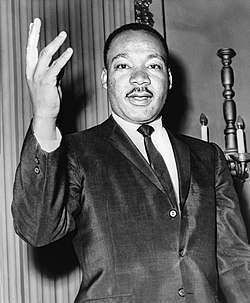
Martin Luther King's Blueprint for Success


Early in December 2009 I gave a presentation speech at the Salisbury East High School graduation and awards ceremony. The basis for the talk was taken from a similar talk given by Martin Luther King. I used notes but I will attempt to give you my speech as closely as possible below.


------------------------------

I want to share something with you. Something that is important to me and is heavy on my heart. Some of you may have heard this before. Some of you may have never heard it before, and I’m glad that you’re here… but before I do, I want to tell you about a man. An ordinary man, but he was a man that believed in something. He stood up for it… and ultimately died for it. But you know… he changed the world.


He lived in a world where the colour of your skin decided whether you were worth anything or not. He lived in a world where the colour of your skin decided whether you could walk down that street, or enter that shop or go to that school.

You see, this man had a dream. A dream that would become famous all over the world. A dream that would have such an impact that the world would be changed forever… but not right away. His dream would be the reason that we would see Barack Obama would create history and become the first African-American President of the United States of America.

Of course, many of you will have worked out by now that the man’s name was Martin Luther King Jr … and he changed the world.

One day, he was talking to a group of students like you, and he asked them a question… I’d like to ask you the same question. First, I’d like to know how many of you know what a blueprint is?

Whenever you construct a building, an architect or draftsperson usually draws up a blueprint… and that blueprint is the guide, the pattern to making sure the building goes up successfully, has a sound structure, and won’t easily fall down.

Just like a building, our lives need a blueprint to make sure they are successful, have a sound structure and don’t easily fall down.


Now, I want to ask you… "What is the blueprint for your life?"

I want to suggest two key things for a sound blueprint for your life.

Number one should be a deep belief in your own sense of dignity. Don’t ever let anyone tell you that you’re nothing, that you’re worthless, that you’re nobody. Never let anyone tell you that you don't matter. You do count. You are worth something. You ARE somebody.

A long time ago, a great king named David famously wrote a profound statement. He said, “I am fearfully and wonderfully made.” He knew that he had been made especially to serve a purpose. He knew he counted. He knew he was somebody. He knew his life had ultimate significance. See, David was a shepherd boy with older brothers that were much bigger and stronger than he was. But it was David who eventually became king. He was handpicked by God. He was unique.


And you see, just like David was unique, you are unique. There is no one else on this planet that is like you. Noone else has your fingerprints, your DNA, your thoughts, your skills. In fact, there is something that each of you can do better than anyone else on the planet. Each one of you were made with the ability to do some things so well that no one can do them as well as you can.

This leads me to my second key point for a sound blueprint for your life. You need the determination to achieve excellence. Many of you have already begun deciding what it is that you will do in life, who you will become, what your life’s work will be. Whatever it is, set out to do it well. Remember, you were fearfully and wonderfully made. You were made with the ability to do some things better than anyone else in the world.

In 1871, a man named Ralph Waldo Emerson said, “If a man can write a better book or preach a better sermon or make a better mousetrap than his neighbour, even if he builds his house in the woods, the world will make a beaten path to his door.”

When you discover what it is that you will be in your life, set out to do it as if God Himself called you at this particular moment in history to do it. Don’t just set out to do a good job. Never accept mediocrity. Instead, set out to do such a good job that the living, the dead or the unborn could never do it any better.


If it falls your lot to be a street sweeper, sweep streets like Michelangelo painted pictures, sweep streets like Beethoven composed music, sweep streets like Shakespeare wrote poetry, sweep streets like Michael Jordan played basketball. Sweep streets so well that all of heaven and earth will stop and say “Here lived a great street sweeper who swept his job well.”

Let me put it another way.

If you can’t be a pine at the top of the hill, be a shrub in the valley. Be the best little shrub on the side of that hill. Be a bush if you can’t be a tree. If you can’t be a highway, just be a trail. If you can’t be the Sun, then be a star. You see, it isn’t by size that you are made a winner or not. It’s whether you are the best you can be of whatever you are.

Just look at many elite footballers. A lot of them are not the most naturally talented players, but those that make it at the elite level simply believed in themselves and worked the hardest to get where they are.

Like them, if you believe in yourself and strive to be the best you can be, then your dreams can come true… and just like Martin Luther King, you can change the world.